
You Don't Have a Focus Problem. You Have a Glue Problem.
How one desktop tool quietly reset the way I run my day, and why the fix was never another app.

My laptop looks like a crime scene.
Thirty-something tabs. Gmail in three accounts. Slack in two workspaces.
Notion open in one window, a Google Sheet in another, Calendar buried somewhere behind a Figma file I haven’t touched in days.
The browser is so heavy the fan sounds like it’s trying to lift off.
I’m 23. I run a Substack with 10K subscribers, an Instagram with 255K followers, a healthcare AI startup, and a content agency. On paper, I am extremely “productive.”
In reality, I just spent eleven minutes looking for a contract a client sent me last week, found it in Downloads named final_FINAL_v3.pdf, and forgot why I needed it by the time I opened it.
That’s the part nobody posts about.
We don’t have a discipline problem. We have a glue problem. And no productivity guru on the internet is going to fix it for you, so I’m going to try.

The Six Assistants Nobody Warns You About
Here’s a thought experiment.
Imagine your company is feeling generous and hires you six personal assistants. Real ones. Salaried.
One of them only touches your email. One of them only manages your calendar. One only knows your files. One lives in Slack. One only opens the browser. One only knows your CRM.
Sounds like luxury, right? Six brilliant people, working only for you.
It’s a nightmare.
Because the email assistant can’t see your calendar. The calendar one doesn’t know what’s in the contract.
The Slack one has never met the CRM one. Every single task needs you in the middle, relaying information like a switchboard operator from 1962.
“Hey, can you tell her what he said, and then check if she’s free, and then put it in the doc the other guy made.”
You are not the founder in that scenario. You are the messenger.
And that’s exactly what 30 open tabs are. Six assistants who refuse to talk to each other. The problem was never that you have too few tools. The problem is that not one of them shares a brain.
A single assistant who can see all of it beats six who each see a slice. Every time. It’s not even close.
So I Stopped Looking for Another App
I have tried so many “all-in-one” tools that I’ve developed a reflex eye-twitch.
Most of them are just a seventh tab. A prettier dashboard you now also have to maintain. They show you your work.
They organize your work. They make your work look gorgeous in a Notion template.
They don’t do the work.
Then a tool called Runner crossed my desk, and the pitch was annoyingly simple: stop asking, start finishing

It’s a desktop app, not a website, not a Chrome extension. It lives on your Mac and it connects to the apps you already pay for.
Gmail, Calendar, Drive, Slack, Notion, GitHub, HubSpot, Linear, and around 50 more. Plus your local files, the actual mess sitting in Downloads and Desktop.
But the connection isn’t the interesting part. Zapier connects things too.
The interesting part is what happens after.
You say: “Show me every open loop across work and life.”
A normal AI tells you how to make a list. Runner goes and checks the three inboxes, the calendars, the Slack DMs, the files, and comes back with: 14 open loops, grouped by owner and deadline, here’s the next action on each.
You say: “Book a review call with Sally and attach last month’s ad numbers.”
It checks the calendars, books the slot, pulls the data, attaches the doc. Kaam ho gaya. Done. Not drafted. Done.
That’s the line that matters. Not “here’s how you could do this.” Just: it’s handled.
The Part That Actually Resets Your Life
One-off tasks are nice. The reset is in the boring, repeating stuff.
Runner lets you save workflows and put them on a schedule, so the same chore runs without you starting it. '
A morning brief that sweeps your inboxes, calendars, and Slack and hands you the day before you’ve had coffee.
A lead that hits your contact form gets enriched, drafted a reply, and pushed to your sales channel, automatically, while you sleep.
This is the “script” idea, except you don’t write code. You describe the job once, in plain English, and it becomes a thing that just happens.
It even supports MCP, so if you’re technical, you can wire it into your own stack. And it runs multiple tasks in parallel, with receipts and timestamps for everything, so you can audit what it actually did.
Here’s the turn most people miss.
Productivity advice is obsessed with helping you do your tasks faster. Runner’s bet is different. The goal isn’t to do your busywork faster. The goal is to not be the one doing it at all.
You stop being the glue. You become the person who decides what gets done, and a system does the relaying. That’s not a small upgrade. That’s a different relationship with your own day.
The company behind it, ArgoNavis, claims busy founders save 6+ hours a week.
I’m not going to repeat a stat I haven’t lived for a year. But I’ll say this: the first time something showed up finished in my inbox that I never started, my brain did a small double-take. That feeling is the whole product.
“But I’m Not Handing My Whole Life to a Robot”
Good. You shouldn’t, not blindly. This is the question I had too.
Giving one tool access to your email, your files, and your CRM is a real decision, and anyone who tells you it isn’t is selling you something.
So here’s the honest version.
Runner runs on a review-before-send model. It asks permission before it takes an action for you, every time.
As you start trusting it, you can switch those guardrails off and let it move fast, but that’s your call, not the default. You choose which apps it touches. You can disconnect any of them, any time.
On the data side: they say they don’t train a model on your stuff, which already puts them ahead of half this industry.
Your data stays encapsulated, your keys are stored securely, and there’s bank-level encryption on it. They’re CASA Tier 2 certified, with SOC 2 audits in progress.
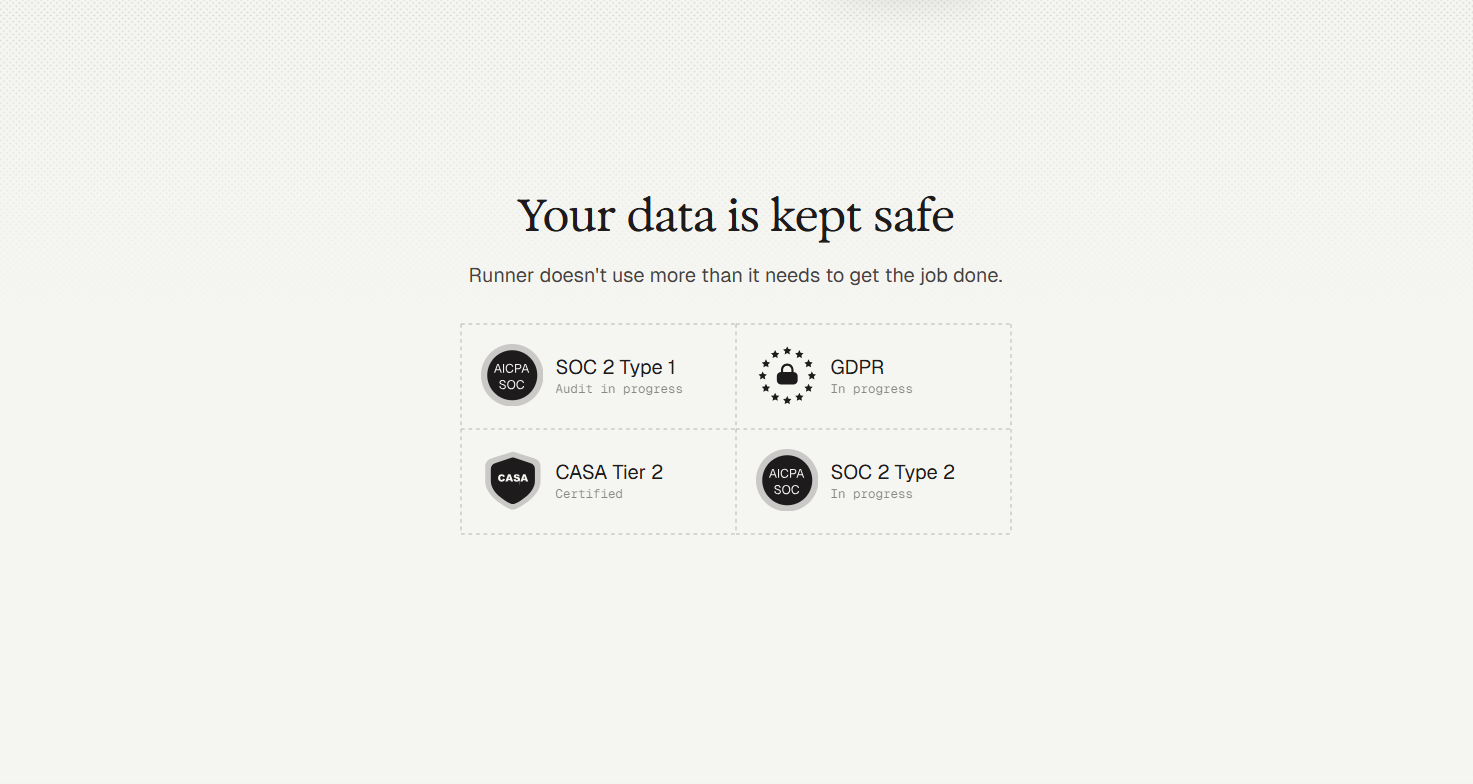
Is it the final, fully-stamped, enterprise-bulletproof version? Not yet, and they say so. The audits are still running. That honesty is actually why I trust the direction more, not less.
You’re not handing over your life. You’re hiring one assistant, on probation, who you can fire with one click. That’s a very different deal than it sounds.
The Entropy Closer
I’ll leave you with this.
The second law of thermodynamics says entropy in a closed system always increases. Left alone, everything drifts from order to chaos.
Your clean desk gets cluttered. Your inbox fills. Your 5 tabs become 30. Nothing tidies itself.
Your digital life is a closed system, and it is always, quietly, getting messier. Every app you add raises the entropy, because now there’s one more thing only you can connect to the others.
The only way to fight entropy is to put energy into the system from outside.
For years, that energy was you. Your focus. Your eleven minutes hunting a PDF. Your brain, acting as the switchboard.
A tool that actually does the work is just outside energy you didn’t have to spend yourself.
You don’t need more apps. You need one that fights the chaos for you.
- Manav
P.S. If you want to try it, Runner has a 7-day free trial and runs on Mac and windows as well. Sign up through this link and you’ll get $50 in credit to start. Connect one app, give it one annoying recurring task, and see if it shows up finished. That’s the only test that matters.
P.P.S. If this one hit a nerve, forward it to the one friend whose laptop also looks like a crime scene. And if you’re new here, subscribe to Tensor Protocol. No schedule. No filler. Just signal.
📖 Worth a look while you’re at it: Runner’s security page lays out exactly what it stores and what it won’t, and the workflow library is the fastest way to steal ideas for what to automate first.